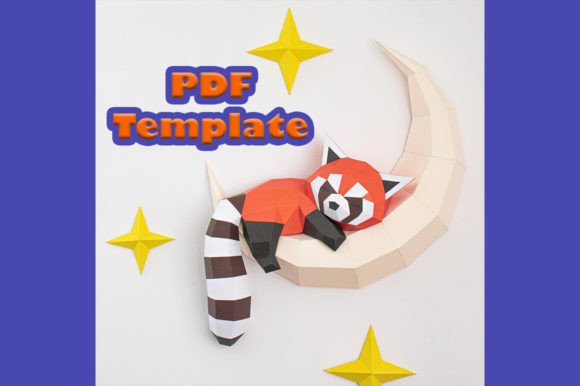
Red Panda on the Moon PDF Template: 3D SVG Asset Review
Evaluating Whimsy for Professional Brand Identity Projects
When sourcing a graphic design asset for a client in the handmade or boutique sector, the line between charming and amateur is incredibly thin. I recently evaluated the Red Panda on the Moon PDF Template while developing a visual identity for an eco-conscious children’s book publisher. My initial impression was that this asset occupies a unique niche within the Other category of digital downloads. It does not present as a flat vector illustration but rather as a structured blueprint for a tactile experience. The mood is distinctly nostalgic yet precise, evoking a sense of quiet wonder that aligns perfectly with modern storytelling brands. For designers accustomed to standard clipart, this template offers a refreshing departure, suggesting depth and craftsmanship even before the physical assembly begins.
The specific nature of this 3D paper craft Red panda on the moon means it carries inherent texture and shadow in its conceptualization. Unlike generic stock vectors, the geometry required for papercraft forces a stylized, low-poly aesthetic that translates beautifully into digital branding. It feels intentional and curated, making it suitable for clients who want their brand identity to reflect patience, artistry, and attention to detail. However, because the product is intended for digital download for making your own paper Red panda on the moon, the designer must understand that the source files are optimized for construction, not just decoration. This distinction is vital when integrating the asset into a broader creative design strategy.
Integrating Papercraft Geometry into Digital and Print Layouts
In my recent project, we needed a hero graphic for a landing page and a recurring motif for packaging. The Red Panda on the Moon PDF Template performed exceptionally well in large layout areas where the geometric facets could be appreciated. As a marketing visual, the angular style of the red panda creates a striking contrast against soft, organic typography. We utilized the rendered views of the model as central elements for social media graphics and Pinterest pins, where the three-dimensional form stopped the scroll more effectively than flat illustration. For packaging design, specifically box sleeves and belly bands, the asset provided a playful yet sophisticated focal point that communicated the brand's commitment to interactive play without relying on loud colors or chaotic compositions.
This asset also shows significant promise for print-on-demand sellers and Etsy product listings. When adapted for t-shirt design or sticker design, the distinct silhouette of the panda against the lunar curve maintains readability at medium sizes. I found that treating the template as a structural guide allowed us to create derivative 2D assets that retained the charm of the original 3D SVG concept. For Cricut project enthusiasts or makers selling physical kits, this template serves as the core digital product, but for graphic designers, it acts as a texture-rich anchor for editorial design and blog visuals. The key is leveraging the "constructed" look to imply value and effort in the final output.
Navigating Visual Hierarchy and Technical Constraints
Despite its strengths, this asset requires careful handling to maintain professional standards. In my review, I noted that the Red Panda on the Moon PDF Template struggles in small-scale applications. The intricate fold lines and geometric segmentation that define the 3D paper craft become visual noise when scaled down for business cards or footer icons. Designers should avoid using this asset in crowded layouts or complex backgrounds where the faceted edges might clash with other detailed elements. It is less effective for minimalist corporate branding or high-contrast technical documents where clean, smooth lines are expected. Instead, reserve this asset for projects where emotional appeal and narrative take precedence over strict utilitarian clarity.
Furthermore, consider the impact on visual hierarchy. Because the model implies depth, it naturally draws the eye. If placed next to critical call-to-action buttons or dense body copy, it may compete for attention rather than support it. In our publishing project, we ensured the panda always had ample negative space, allowing it to function as a breathing point in the layout. For sublimation design or merchandise like mugs and tote bags, test the contrast rigorously. The subtle shading that makes the paper model look 3D can sometimes flatten out during printing if the color profile isn't managed correctly. Always verify that the asset supports the intended emotional tone; it is inherently gentle and imaginative, which may not suit aggressive sales campaigns or luxury fashion branding.
Pre-Flight Checks for Commercial Application and Licensing
Before committing this asset to a paid client deliverable, a thorough technical audit is non-negotiable. First, confirm the commercial license terms explicitly. Since this is a specialized template requiring 14 sheets of thick paper and specific assembly, the licensing for the digital file versus the physical end-product may differ. Next, inspect the file formats. While categorized under Other, verify if a true editable SVG design is included alongside the PDF. If you are adapting the artwork for a Canva template or web graphics, you may need to trace or render the model yourself. Check PNG transparency if you plan to layer the panda over colored backgrounds; jagged edges from improper masking can ruin the illusion of quality.
- Contrast Testing: Preview the asset in grayscale to ensure the geometric planes remain distinguishable without color reliance.
- Typography Pairing: Test against serif fonts for a storybook feel, and rounded sans-serifs for a modern maker vibe. Avoid sharp, industrial typefaces that clash with the organic paper aesthetic.
- Mockup Validation: Never approve the design based on screen view alone. Place the asset on real-world product mockups to judge scale and texture interaction.
- Print Quality: If using the PDF for physical assembly as part of a branded kit, print a test sheet on the recommended thick paper to verify line weight and score mark accuracy.
- File Integrity: Ensure all layers are intact and that no stray anchor points exist if editing the vector paths for custom design assets.
Final Verdict on Versatility and Client Value
Ultimately, the Red Panda on the Moon PDF Template is a high-value asset for the right context. It bridges the gap between digital convenience and analog warmth, a combination that is increasingly rare in the creative marketplace. For small business branding, particularly in niches involving education, nursery decor, or artisanal crafts, it offers a level of specificity that generic stock cannot match. The requirement for 14 sheets of thick paper and additional materials for the physical build speaks to a dedication to quality that resonates with discerning audiences.
As a professional designer, I recommend this asset for projects where the goal is to evoke curiosity and tactile engagement. It excels as a centerpiece for web design hero sections, thematic campaign visuals, and interactive printable design products. However, it demands respect for its technical origins. Treat it not merely as a picture of an animal, but as a blueprint for an experience. When used with intentionality and proper pre-flight checks, this template elevates a brand from simply being seen to being felt, providing a memorable anchor in a saturated digital landscape. Just remember to validate that the whimsical, constructed aesthetic aligns with your client’s long-term vision before integrating it into their core design bundle or identity system.